The Thumbtrap: Understanding Why Your Thumb Won't Stop Scrolling (And How to Finally Escape)
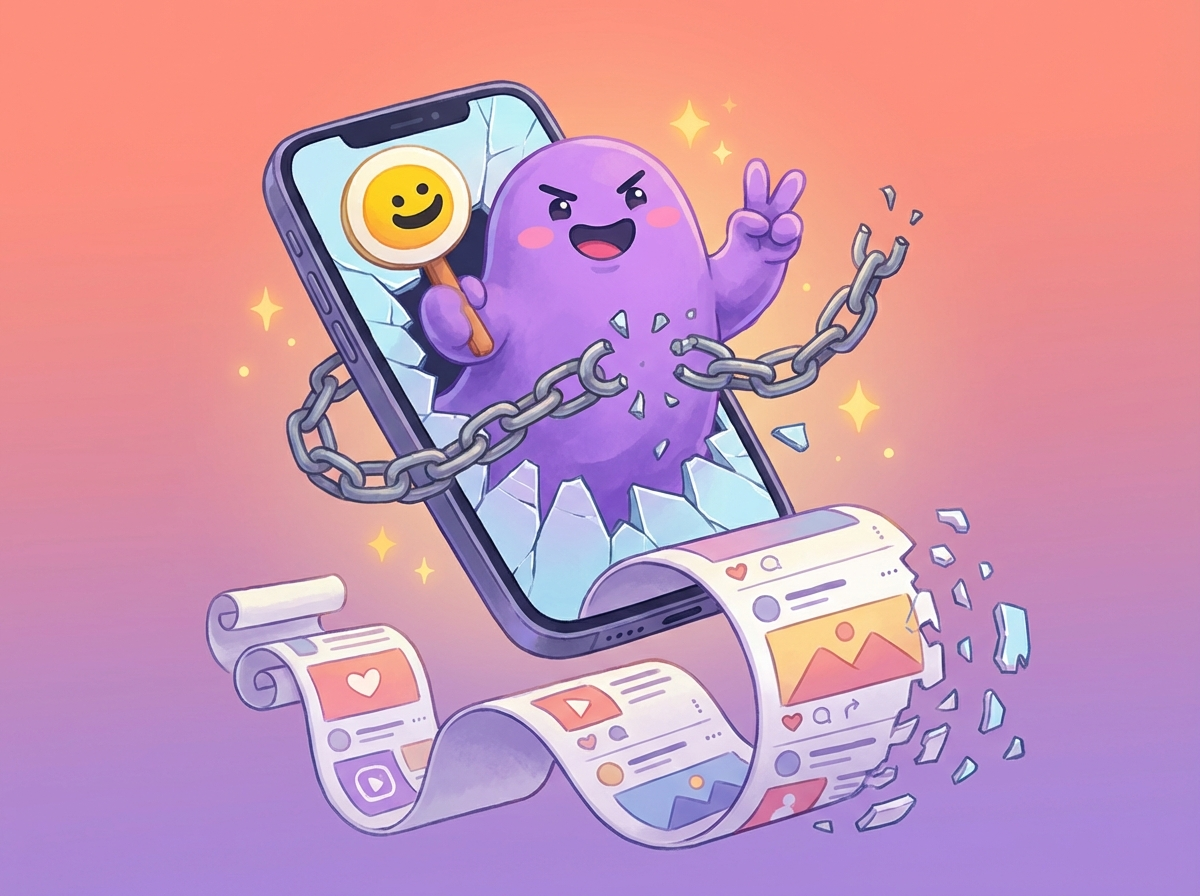
"The thumbtrap is a metaphor drawn from Chinese finger traps—those woven tubes where pulling harder to escape just makes you more stuck. Compulsive scrolling works the same way: the harder you try to stop through willpower and resistance, the more the behavior persists."
There's a toy that has been teaching people about traps for hundreds of years. You may have encountered it at a childhood birthday party or received one in a gift bag at a carnival. It's a woven tube, usually made from bamboo or paper, about five inches long and just wide enough to slip a finger in each end. It's called a Chinese finger trap, and it contains a lesson that millions of smartphone users desperately need to learn.
The trap is elegant in its deception. You put your fingers in, you try to pull them out, and the harder you pull, the tighter the trap grips. Every instinct tells you to pull harder—escape requires effort, right? But pulling is exactly what keeps you stuck. The trap tightens in response to pulling because the weave is designed to constrict under tension. The only way out is counterintuitive. You have to push your fingers together, relaxing the weave, creating slack, and then gently sliding free. The escape requires releasing the struggle, not intensifying it.
Your relationship with your phone works exactly the same way.
Every time you tell yourself you're going to stop scrolling and then white-knuckle your way through an hour of willpower before inevitably caving, you're pulling harder on the finger trap. Every time you feel shame about how much time you've wasted and then use that shame to motivate a new attempt at restriction, you're pulling harder. Every time you delete an app only to reinstall it three days later, you're demonstrating that the trap tightens in response to force.
The scrolling doesn't stop because you're fighting it wrong. You're caught in what researchers and behavior designers have come to call the thumbtrap—a combination of psychological mechanisms so powerful that direct resistance only strengthens their hold. Understanding why this happens is the first step toward actually escaping.
This isn't about willpower. It's about understanding how the trap works and finding the specific intervention points where gentle pressure actually creates freedom. Let's examine the mechanics of your cage.
Understanding the Thumbtrap Mechanics
The Slot Machine in Your Pocket: Variable Reinforcement and Why Your Brain Can't Quit
Before we can understand why escape is so difficult, we need to understand exactly what's keeping you trapped. The first mechanism is something that casinos have known about for decades and that social media companies have weaponized more effectively than anyone could have predicted. It's called a variable reinforcement schedule, and it is one of the most powerful behavior-shaping tools ever discovered by psychological science.
In the 1930s and 1940s, psychologist B.F. Skinner conducted experiments that would eventually make billions of dollars for the gambling and tech industries. He was studying operant conditioning—how behaviors become strengthened or weakened based on their consequences—and he discovered something that seemed counterintuitive at first. Skinner trained rats to press levers for food pellets, varying the patterns of reward delivery to see how different schedules affected behavior. When rats received a pellet every time they pressed the lever, they learned the behavior quickly but pressed at a moderate, predictable rate. They knew what to expect, so they engaged when hungry and stopped when satisfied.
But when Skinner made the rewards unpredictable—sometimes the lever produced food, sometimes it didn't, and there was no way to predict which—something remarkable happened. The rats became obsessed. They pressed compulsively, far more than rats on predictable schedules. They pressed when they weren't hungry. They kept pressing long after the rewards stopped coming entirely, in a phenomenon called resistance to extinction that has since been documented in hundreds of studies. The unpredictability itself was creating the compulsion.
Casinos understood Skinner's work immediately. Slot machines are variable reinforcement schedules made physical. You pull the lever, sometimes you win, usually you don't, and you never know which outcome is coming. The unpredictability is the point. Research by Natasha Dow Schüll, published in her book 'Addiction by Design: Machine Gambling in Las Vegas,' documented how modern slot machines are engineered using behavioral psychology principles to maximize what the industry calls 'time on device'—how long players continue gambling regardless of outcomes.
Now consider your social media feed. Every scroll is a lever pull. Sometimes you get something interesting or funny or enraging or beautiful—a small jackpot. Usually you get nothing particularly noteworthy—no payout. But you never know what's coming next, so your brain stays locked in anticipation mode, waiting for the next potential reward.
To understand why variable reinforcement is so powerful, you need to understand how dopamine actually works—and most people have this wrong. The popular understanding is that dopamine is a pleasure chemical. You get something you want, dopamine releases, you feel good. This model is incorrect. Research by Wolfram Schultz at Cambridge University demonstrated that dopamine neurons don't fire primarily when you receive a reward. They fire during the anticipation of a possible reward—and they fire most strongly when the reward is uncertain. Your dopamine system doesn't reward you for finding good content. It rewards you for the possibility of finding good content. The anticipation is the hit, and variable reinforcement maximizes anticipation.
Here's where it gets especially insidious. You might think that the boring or negative content in your feed would reduce engagement by being unrewarding. The opposite is true. Remember, dopamine is maximized by uncertainty. A feed that was consistently good would actually be less compelling than one that mixes good content with garbage, because the reliable feed would reduce uncertainty. The content you hate—the inflammatory political takes, the anxiety-inducing news, the posts that leave you feeling worse—is not reducing the dopamine loop. It's maintaining the unpredictability that maximizes dopamine during anticipation. Your thumb keeps moving through content that makes you feel terrible because feeling terrible doesn't interrupt the dopamine mechanism. Only certainty about outcomes would do that, and the feed is specifically designed to prevent certainty.
The Automatic Thumb: How Habit Loops Bypass Your Conscious Mind
variable reinforcement explains why scrolling is compelling. But it doesn't fully explain why you often scroll without consciously deciding to—why you pick up your phone and find yourself ten minutes into Instagram before you realize you've done anything. For that, we need to understand the habit loop and how automatic behaviors operate outside of conscious control.
Your brain runs on two fundamentally different systems. Psychologist Daniel Kahneman, in his book 'Thinking, Fast and Slow,' popularized the terminology of System 1 (fast, automatic, unconscious) and System 2 (slow, deliberate, conscious). But the underlying neuroscience involves distinct brain structures. Deliberate, conscious decision-making is mediated primarily by your prefrontal cortex—the most recently evolved part of your brain, responsible for planning, reasoning, and what we call willpower. When you consciously decide to do something, your prefrontal cortex is engaged.
But automatic, habitual behaviors are run by a different structure entirely: the basal ganglia, a collection of nuclei deep in your brain that handles procedural memory and automatic action sequences. When you perform a habit, the basal ganglia runs the program while your conscious mind can be elsewhere entirely. This division of labor is efficient. You can drive a familiar route while having a conversation because your basal ganglia handles the driving while your prefrontal cortex handles the talking.
The problem is that scrolling has become an automatic behavior for most smartphone users. The action sequence—hand moves to phone, thumb unlocks, thumb opens app, thumb scrolls—has been repeated so many times that it's been chunked into a basal ganglia program that runs without conscious initiation. Research by Wendy Wood at USC, published in the Journal of Personality and Social Psychology, found that approximately 43% of daily behaviors are performed habitually rather than deliberately. Her research demonstrated that habits are triggered by contextual cues and run automatically once triggered, with conscious override being effortful and unreliable.
Charles Duhigg, in 'The Power of Habit,' popularized the habit loop model based on research from MIT's McGovern Institute. Every habit operates through a three-part structure: cue, routine, and reward. The cue is the trigger that initiates the habit—it can be a location (sitting on the couch), a time (first thing in the morning), an emotional state (feeling bored or anxious), a preceding action (finishing a task), or other people (being alone). When the cue is present, the habit loop activates. The routine is the behavior itself—the automatic action sequence that runs once triggered. The reward is what the brain gets from the behavior—not necessarily conscious pleasure, but neurochemical consequences that reinforce the loop.
Here's what makes habits so difficult to break: once the cue-routine-reward loop is established, the routine runs automatically when the cue is present. Your conscious mind doesn't get a vote until the behavior is already underway. Research by Phillippa Lally at University College London found that once formed, habits persist even when the reward is no longer delivered or is delivered unpredictably. The basal ganglia doesn't easily unlearn patterns.
Apply this to your scrolling behavior and you'll understand why 'just deciding to stop' doesn't work. You're sitting on the couch after dinner (cue). Before you've consciously decided anything, your hand has moved to your phone, unlocked it, and opened the app (routine). By the time your conscious mind notices what's happening, you're already scrolling. The behavior wasn't initiated by a conscious decision. It was triggered by a cue and executed automatically by your basal ganglia. Your prefrontal cortex—the part that made the resolution to scroll less—wasn't involved in starting the behavior.
There's something that often surprises people trying to understand their scrolling: the physical act of scrolling, independent of content, may be neurologically soothing. Research on repetitive motor behaviors shows that rhythmic, repetitive movements can activate the parasympathetic nervous system and reduce cortisol. The thumb-scroll motion is rhythmic and repetitive. Flick, pause, flick, pause. For many people, this motion has become associated with nervous system regulation through repeated pairing with the mild relief of distraction. This means the routine itself may be providing reward, independent of the content. Your basal ganglia has learned that the scroll motion leads to a subtle shift in physiological state—a tiny bit less stress, a tiny bit more engagement—and this micro-reward reinforces the behavior.
Infinite Scroll: The Physical Architecture of the Trap
We've established that variable reinforcement makes scrolling compelling and that habit loops make scrolling automatic. But there's a third element that transforms compulsion and automaticity into a trap with no exit: the physical design of infinite scroll itself.
Before 2006, websites had pagination. You'd load a page of content, view it, and reach the bottom. To see more, you'd have to click a 'next page' button or a number. That click was a moment of friction, a tiny pause where your conscious mind could intervene and ask, 'Do I actually want to continue?' Aza Raskin invented infinite scroll in 2006 while working at Humanized, later acquired by Mozilla. The feature eliminated pagination entirely. New content loads automatically as you approach the bottom of what's currently visible. There is no bottom. There is no end. The feed continues forever.
Raskin has since expressed regret about his invention. In interviews with the BBC and other outlets, he has stated that infinite scroll was designed for convenience but has been weaponized for engagement at the expense of user wellbeing. He has estimated that infinite scroll adds roughly 200 million hours of additional daily usage to social media platforms globally. The removal of stopping points isn't an accidental byproduct of the design. It's the entire purpose. Internal documents from social media companies, revealed through various investigations and whistleblower disclosures, show that engagement metrics—time on site, scroll depth, session length—are the primary optimization targets. infinite scroll directly serves these metrics by eliminating any natural point where users might disengage.
Human behavior is strongly influenced by environmental structures that signal completion. When you read a book, the shrinking number of pages on the right tells you how close you are to finishing. When you eat from a plate, the emptying plate signals that the meal is ending. When you watch a movie, the runtime counter tells you how much remains. These completion signals trigger what psychologists call 'hedonic adaptation endpoints'—moments where your brain can assess satisfaction and decide whether to continue or stop.
infinite scroll creates a self-refilling bowl of content. The feed never empties. The signal that would tell your brain 'you've seen what's here' never arrives because there's always more that you haven't seen. Research published in Computers in Human Behavior found that users who viewed content with infinite scroll consumed significantly more content than those who viewed the same content with pagination, even when controlling for content quality and user interest. The interface architecture itself drove increased consumption.
There's a physical metaphor here that's worth dwelling on. Imagine riding a bicycle down a hill. The momentum builds as you descend, and you need to apply brakes to slow down. Now imagine the same hill, but someone has removed your brakes. The momentum continues building indefinitely, and you have no mechanism for stopping except crashing. infinite scroll removes the brakes from content consumption. The habit loop provides momentum—each cue triggers scrolling, each scroll provides micro-reward. variable reinforcement adds fuel—the anticipation of possible rewards keeps you engaged. And infinite scroll removes any natural mechanism for stopping.
The three mechanisms combine into a trap that feels inescapable because, within its own logic, it is. As long as you're engaging with the system as designed, there's no point at which the system tells you to stop. You can only stop through external intervention—running out of battery, being interrupted by another person, physically removing the device from your hands. This is why time disappears during scrolling. There are no markers, no checkpoints, no chapter endings. One scroll blends into the next in an undifferentiated stream that could be five minutes or five hours. Research on time perception shows that estimating duration requires discrete events to count. infinite scroll minimizes discrete events, making time estimation functionally impossible.
The Chinese Finger Trap: Why Fighting Makes It Worse
Now we arrive at the core insight of the thumbtrap metaphor—the reason why willpower-based approaches to reducing scrolling not only fail, but often make the problem worse.
Willpower is mediated by your prefrontal cortex, and the prefrontal cortex has limited capacity. Research by Roy Baumeister and colleagues, published in numerous papers beginning in the late 1990s, established the 'ego depletion' model: self-control draws on a limited resource that depletes with use. Later research has somewhat complicated this model—the depletion effect may be smaller than initially thought, and may depend on beliefs about willpower as well as actual capacity. But the core finding has held up: sustained self-control is effortful and becomes more difficult over time, especially when you're tired, stressed, hungry, or emotionally taxed.
This means that relying on willpower to resist scrolling puts you in a losing position. You might successfully resist for hours or even days, but the automatic systems pushing you toward scrolling never tire. They wait patiently for the moment when your prefrontal cortex is depleted—late at night, after a stressful day, when you're feeling emotionally vulnerable—and then the habit loop activates and the scrolling begins. Research by Wilhelm Hofmann and colleagues found that desires were resisted about 50% of the time on average, and that the success rate dropped significantly as the day progressed and as other stressors accumulated. For scrolling specifically, this means that your best-intentioned morning resolve to stay off social media is least effective precisely when you most need it—in the evening when you're tired, or during stressful moments when the phone offers easy escape.
Here's where the finger trap mechanism becomes vicious. When you fail to resist scrolling—and you will, because the systems are stronger than willpower—you feel shame. You feel like you've failed. You feel weak, undisciplined, out of control. What does shame feel like in the body? It feels like stress. It activates your threat response, elevates cortisol, and creates psychological discomfort that demands relief. And what have you learned to do when you feel stressed and uncomfortable? Scroll. The shame about scrolling becomes a cue that triggers more scrolling. The harder you try and fail, the more shame accumulates. The more shame accumulates, the more you need to escape it. The more you need to escape, the more attractive the numbing comfort of the scroll becomes.
This is the finger trap mechanism in action. Pulling harder—trying to willpower your way out through force and self-criticism—tightens the trap. Each failure generates shame, and shame drives the behavior you're trying to stop. Research on shame and addiction by Brené Brown and others has documented this pattern across multiple compulsive behaviors. Shame rarely motivates lasting change; instead, it typically drives people deeper into the behavior that temporarily provides escape from shame's pain.
Willpower approaches often manifest as restriction attempts: deleting apps, setting screen time limits, putting your phone in another room. These can work temporarily, but they often lead to what researchers call the restriction-binge pattern. During restriction, you successfully avoid the behavior. But the habit loop hasn't changed—the cues still exist, the basal ganglia still contains the routine, and the reward circuits still associate scrolling with relief. You've put up a barrier, but the underlying systems remain intact. Then something happens—stress, depletion, a moment of weakness—and the barrier falls. You reinstall the app, you bypass the screen time limit, you retrieve the phone. And now you don't just scroll; you binge. The restriction has created pent-up demand that expresses itself as compensatory excess.
Let's make the finger trap metaphor concrete. In the Chinese finger trap, the harder you pull, the tighter the weave grips your fingers. In the thumbtrap: trying harder to resist through willpower depletes a limited resource while the automatic systems remain at full strength, ensuring eventual failure. Feeling shame about failure creates stress that triggers the behavior you're trying to stop, generating a self-reinforcing cycle. Implementing strict restrictions creates rebound effects where usage after restriction exceeds the original level. Every conventional approach—trying harder, feeling worse about yourself, implementing stricter rules—makes the trap tighter.
The Escape: Intervention Points and Re-Scrolling
If pulling harder doesn't work, what does? How do you escape a trap that tightens in response to struggle? The answer comes from understanding that the thumbtrap, like the finger trap, has specific structural weaknesses. There are points in the system where gentle pressure—not forceful pulling—can create slack and allow escape. In behavior change science, these are called intervention points: locations in the habit loop where change is achievable with minimum resistance from the automatic systems.
The first intervention point is modifying the cues. The habit loop begins with cues. No cue, no trigger. No trigger, no automatic routine. Research on habit disruption by Wendy Wood shows that the most effective time to change habits is during life transitions—moving to a new home, starting a new job, traveling—because the environmental cues change. You can create mini-transitions by modifying the cues that trigger your scrolling. If location is a cue, change your relationship with that location. If the phone's visibility is a cue, remove it from sight. If specific apps are cues, make them harder to access. Research published in Psychological Science found that simply increasing the physical distance to unhealthy snacks reduced consumption dramatically, even though the snacks remained available. The same principle applies to digital consumption: increasing friction reduces automatic activation without requiring willpower.
The second intervention point is disrupting the routine. Implementation intentions are one evidence-based approach. Developed by Peter Gollwitzer, implementation intentions are if-then plans that pre-program a new response to an existing cue. 'If I pick up my phone, then I will take three breaths before opening any app.' Research shows that implementation intentions are significantly more effective than simple goal intentions because they work with the automatic systems rather than against them. You're not trying to override the habit; you're inserting a micro-pause into the sequence.
The third intervention point is the most powerful: redirect rather than eliminate. Here's where the finger trap wisdom becomes most practically useful. In the finger trap, you don't escape by pulling out; you escape by pushing in and then sliding free. The solution works with the trap's structure rather than against it. In the thumbtrap, you don't escape by eliminating scrolling; you escape by redirecting what you scroll through.
Your basal ganglia has learned the scroll routine. That routine is chunked and automatic. Trying to eliminate it through willpower is fighting the finger trap. But the content you scroll through is variable and changeable. The same thumb motion, the same variable reinforcement from unpredictable content, the same habit loop structure—but different content that regulates instead of dysregulates your nervous system.
This is re-scrolling: the practice of using the same thumb gesture and scroll mechanic you've already developed, but directing it toward content that regulates your nervous system rather than dysregulating it. Your brain has already automated the scroll behavior—that automation isn't going away. Re-scrolling leverages this existing habit by changing what you scroll through rather than trying to eliminate scrolling entirely. You still get the dopamine of variable rewards and the comfort of familiar behavior, but the content delivers calm instead of chaos.
Think about what you already have: a thoroughly trained thumb that moves automatically, a dopamine system that responds to variable content, an established relationship between phone interaction and nervous system regulation (even if that regulation was actually dissociation). These aren't problems to eliminate. They're infrastructure to redirect. A feed curated for calm, interesting, beautiful, or inspiring content gives you the same dopamine-driven anticipation and satisfies the same habit loop, but delivers different physiological and psychological outcomes.
Research on behavioral substitution supports this approach. Studies on addiction treatment show that replacing a harmful behavior with a similar-but-healthier behavior is more effective than attempting to eliminate the behavior with nothing in its place. The neural pathways that drive the behavior need somewhere to go; giving them a beneficial outlet produces better outcomes than trying to simply block them. Research published in Computers in Human Behavior in 2023 found that participants who were guided to curate their social media feeds for calming content showed improvements in wellbeing while maintaining engagement with platforms. The scroll behavior continued; the outcome changed.
You're reading this on a device that's probably in your pocket or within arm's reach right now. By the time you finish this sentence, the urge to check it may have already flickered through your awareness. That's not weakness. That's a beautifully engineered habit loop, honed by thousands of hours of repetition and powered by neurological systems that evolved long before anyone imagined a pocket-sized dopamine delivery device. The thumbtrap is real. But the trap has weak points. The cues can be modified. The automatic routine can be disrupted. Most importantly, the content that flows through the scroll mechanic can be changed while the mechanic itself remains intact. Your thumb is going to move. The question is where it takes you.
Scientific Context
Research from behavioral psychology, neuroscience, and addiction studies converges on a key finding: variable reinforcement schedules, habit loops, and infinite scroll combine to create compulsive engagement that resists direct willpower-based intervention. The most effective approaches work with these mechanisms rather than against them.
Related Reading
Regulation shouldn't be work.
Recognition of these principles has led to the development of apps specifically designed to enable beneficial scrolling. Nomie curates content explicitly for nervous system regulation, providing the scroll interface and variable content your brain expects while engineering the content selection for positive wellbeing outcomes.
The distinction from traditional social media is that the optimization target is different. Traditional social media optimizes for engagement metrics—time on site, scroll depth, session length—without regard for how users feel afterward. Nomie optimizes for how users feel, selecting content based on regulating properties rather than maximum stickiness.
Re-scrolling isn't about defeating your thumb. It's about letting your thumb do what it's learned to do—scroll, seek, engage—while changing what it scrolls through. The same gesture that currently delivers anxiety and dissociation can deliver calm and presence. The same habit loop that currently dysregulates your nervous system can become a tool for regulation.
You don't escape the Chinese finger trap by pulling harder. You escape by pushing in, creating slack, and sliding free. You don't escape the thumbtrap by fighting scrolling. You escape by redirecting the scroll toward content that serves you, working with the trap's structure rather than against it.
Frequently Asked Questions
Why can't I stop scrolling even when I want to?
Scrolling activates multiple brain systems that operate below conscious awareness. variable reinforcement schedules create dopamine-driven anticipation, while automatic habit loops bypass deliberate decision-making entirely. Your thumb moves before your conscious mind decides anything. This is why willpower approaches fail—you're trying to consciously override automatic processes that were designed to run without conscious input. The solution isn't more willpower; it's intervening at specific points in the habit loop where change is actually possible.
What is the thumbtrap and why is it called that?
The thumbtrap is a metaphor drawn from Chinese finger traps—those woven tubes where pulling harder to escape just makes you more stuck. Compulsive scrolling works the same way: the harder you try to stop through willpower and resistance, the more the behavior persists. Shame and guilt about scrolling create stress, and stress triggers the very coping behavior you're trying to stop. The solution, like the finger trap, requires relaxing into the problem rather than fighting it—redirecting the scroll habit rather than trying to eliminate it entirely.
Why does infinite scroll make it so hard to stop?
infinite scroll removes all natural stopping points from the browsing experience. Before infinite scroll, websites had pagination—you'd reach the end of a page and have to deliberately click 'next' to continue. That moment of friction allowed conscious decision-making to intervene. infinite scroll eliminates this entirely, creating a seamless experience with no natural breaks where your conscious mind can ask 'should I still be doing this?' The content never ends, so your scrolling never has a logical endpoint.
What is a variable reinforcement schedule and why is it so addictive?
A variable reinforcement schedule is a pattern where rewards are delivered unpredictably rather than consistently. This unpredictability is neurologically more compelling than reliable rewards because it maximizes dopamine release during the anticipation phase. Slot machines, social media feeds, and your notifications all use this mechanism. Research shows that rats on variable schedules will press levers until exhaustion, far more compulsively than rats who receive predictable rewards. The uncertainty itself becomes the addiction.
Why doesn't willpower work for stopping compulsive scrolling?
Willpower is mediated by your prefrontal cortex—the conscious, deliberate part of your brain. But scrolling habits operate through the basal ganglia, a structure that runs automatic behavior patterns without requiring conscious input. You can't willpower your way out of an automatic behavior any more than you can willpower yourself to stop blinking. Additionally, willpower is a depletable resource that's weakest exactly when you most need it: when you're tired, stressed, or emotionally depleted. Effective solutions target the habit loop directly rather than relying on conscious override.
What are intervention points and how do they help break the scroll habit?
Intervention points are specific locations in the habit loop where change is most achievable. The habit loop consists of cue, routine, and reward. Rather than trying to stop the routine through willpower (which fails), you can modify the cue (changing what triggers scrolling), insert friction before the routine (making it harder to start), or redirect the routine while preserving the reward (scrolling for regulating content instead of stressful content). Each intervention point requires less willpower than direct resistance because you're working with the brain's automatic systems rather than against them.
What is re-scrolling and how does it work?
Re-scrolling is the practice of using the same thumb gesture and scroll mechanic you've already developed, but directing it toward content that regulates your nervous system rather than dysregulating it. Your brain has already automated the scroll behavior—that automation isn't going away. Re-scrolling leverages this existing habit by changing what you scroll through rather than trying to eliminate scrolling entirely. You still get the dopamine of variable rewards and the comfort of familiar behavior, but the content delivers calm instead of chaos.
How long does it take to change a scrolling habit?
Research on habit formation suggests that automatic behaviors take 18 to 254 days to establish, with 66 days being the average. Changing an existing habit is often faster than forming a new one from scratch because you're modifying existing neural pathways rather than building new ones. Most people report noticeable shifts in their scrolling patterns within 2-3 weeks of implementing intervention points, with more substantial changes occurring over 6-8 weeks. The key is consistency with the interventions rather than perfection.
Continue Reading
View All PostsNomie vs Finch: Somatic AI Wellness or Virtual Pet Gamification?
Finch gamifies self-care with a virtual pet bird. Nomie calms your nervous system with somatic tools. Here's which approach actually fits your needs.
Anxiety Dizziness and Lightheadedness: Why It Happens and What Helps
Feeling dizzy during anxiety can be terrifying—but it’s usually a nervous-system + breathing effect, not a sign you’re about to faint. Learn common causes and how to steady yourself.
Anxiety Tingling and Numbness: Causes, Meaning, and How to Stop It
Pins and needles during anxiety can feel alarming—especially in hands, face, or lips. Learn why it happens (often breathing + adrenaline) and how to calm it down safely.