Executive Dysfunction Hacks: When Your Brain Won't 'Just Do It'
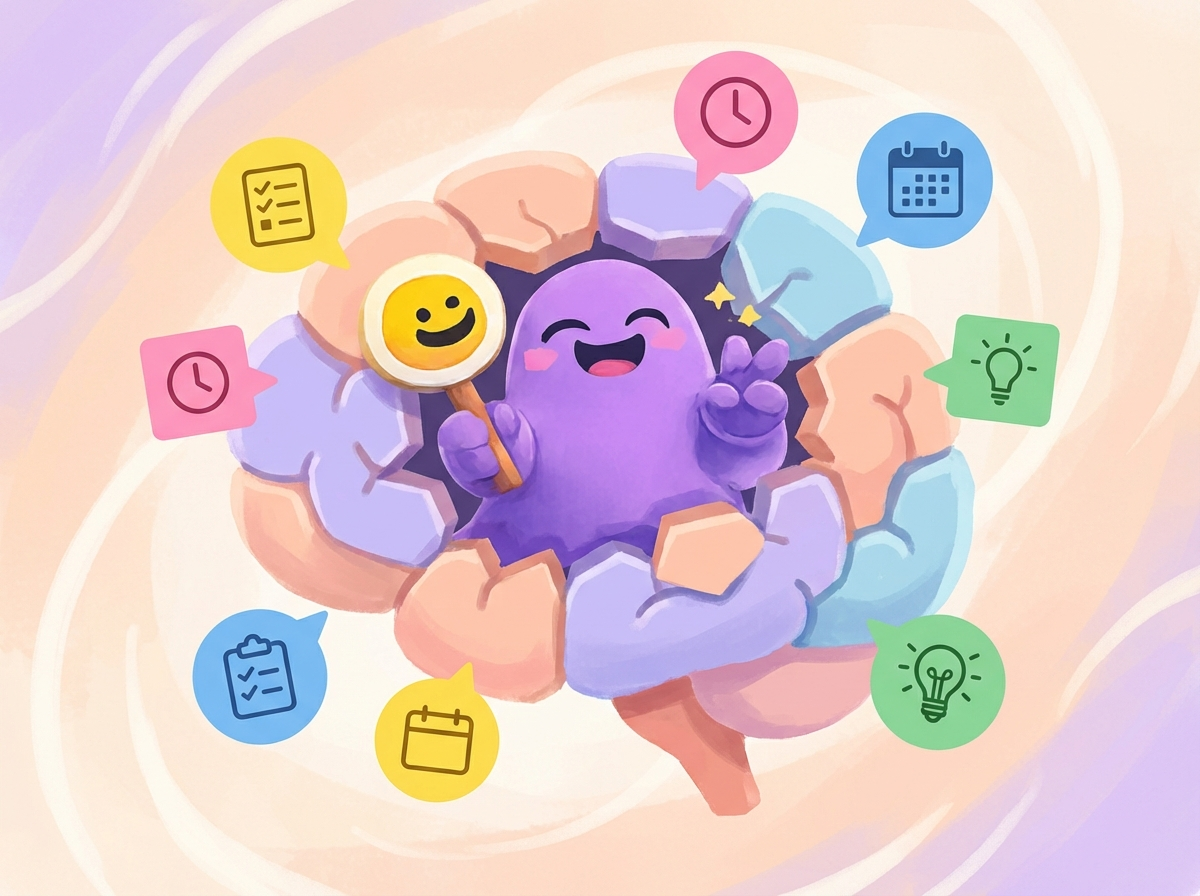
"Executive dysfunction is a neurological impairment affecting the brain's executive functions—the cognitive processes responsible for planning, working memory, attention, problem-solving, and task initiation. It's not laziness, but a disconnect between knowing what to do and being able to initiate doing it."
Working With Your Brain, Not Against It
Understanding Executive Dysfunction: The Science Behind the Struggle
You know exactly what you need to do. The email that needs sending. The dishes in the sink. The project with the deadline that's approaching like a freight train. You've known for hours. Maybe days. You've thought about it so many times you could recite every step from memory. You've even opened the document, the app, the cabinet door. And then somehow, mysteriously, inexplicably, you find yourself three hours later having reorganized your entire bookshelf by color while the original task sits untouched, mocking you with its continued existence. This is not a willpower problem. This is not laziness. This is not a character flaw or a moral failing or evidence that you simply don't want it enough. What you're experiencing has a name, a neurological basis, and most importantly, actual strategies that work with your brain instead of against it.
Executive functions are the cognitive processes that allow us to manage ourselves and our resources in order to achieve a goal. Dr. Russell Barkley, one of the world's leading researchers on ADHD and executive function, describes them as the brain's management system. These functions include working memory—the ability to hold information in mind while using it. They include cognitive flexibility—the capacity to switch between thinking about different concepts or to think about multiple concepts simultaneously. They encompass inhibitory control—the ability to suppress dominant responses in favor of more appropriate ones. And crucially, they include the ability to initiate tasks, which is where so many of us find ourselves completely stuck.
Think of executive functions as the conductor of an orchestra. The musicians, which represent your knowledge, skills, and intentions, might all be present and capable. But without the conductor to coordinate them, to signal when to start, to keep everyone moving in the same direction, you get cacophony instead of symphony. executive dysfunction is what happens when the conductor calls in sick but the concert is still scheduled. Neuroimaging studies have consistently shown that executive functions are primarily mediated by the prefrontal cortex, the brain region right behind your forehead. Research published in the journal Neuropsychology Review demonstrates that this region acts as a kind of control center, regulating attention, planning, and the initiation of goal-directed behavior. When this region isn't functioning optimally, whether due to ADHD, depression, anxiety, sleep deprivation, chronic stress, or a host of other factors, the result is what clinicians call executive dysfunction.
Here's where things get interesting, and by interesting, I mean frustrating but also validating. executive dysfunction isn't about motivation in the way we typically think about it. It's about the neurological pathways that translate motivation into action. Dr. Barkley's research has shown that ADHD, one of the primary conditions associated with executive dysfunction, creates what he calls 'time blindness' and an impairment in self-regulation. But perhaps his most crucial insight is this: ADHD is not a problem of knowing what to do, but a problem of doing what you know. The knowledge is there. The desire is there. The understanding of consequences is there. What's impaired is the bridge between knowing and doing. This distinction matters enormously because it explains why all those well-meaning suggestions to 'just try harder' or 'just focus' or 'just start' feel so hollow. You can't try harder at a neurological process any more than you can try harder at digesting your food.
Why 'Just Do It' Is Neurologically Impossible
Nike's famous slogan has done immeasurable damage to people with executive dysfunction. Not because it's bad advice for neurotypical people, but because it has become a cultural shorthand for the belief that action is purely a matter of will, and that anyone who can't 'just do it' is somehow choosing not to. The willpower model of human behavior suggests that we have some finite resource called willpower or self-control, and that successful action is simply a matter of applying enough of this resource to a task. Under this model, failure to act is interpreted as either insufficient willpower or insufficient motivation, both of which imply personal failing.
The problem is that this model doesn't account for the neurological reality of executive function. Research by Dr. Roy Baumeister on ego depletion initially seemed to support the willpower model, but subsequent studies, including large-scale replication attempts, have raised significant questions about whether willpower works this way at all. More importantly, even if willpower is a real and finite resource, that model still doesn't explain why some people seem to need vastly more of it than others to accomplish the same basic tasks. What the willpower model misses is that task initiation itself requires intact executive function. Before you can apply willpower to a task, you have to be able to start the task. And starting, it turns out, is not a simple binary switch but a complex neurological process involving multiple brain regions, neurotransmitter systems, and cognitive processes. When any part of this system is compromised, 'just doing it' becomes neurologically impossible, regardless of how much you want to do it or how hard you try.
Researchers have a term for the disconnect between what we intend to do and what we actually do: the intention-action gap. While everyone experiences some version of this gap, for people with executive dysfunction, it's not a gap but a chasm. Studies using functional MRI have shown that when neurotypical individuals form an intention to act, there's a cascade of neural activity that moves from the prefrontal cortex through the motor planning regions and eventually to the motor cortex, which initiates the physical action. In people with executive dysfunction, this cascade can stall at various points, particularly in the transition from prefrontal planning to motor initiation. This is why you can lie in bed thinking about getting up for hours without actually getting up. It's why you can open a document and then close it twenty times without typing a word. The intention is formed, but the signal to act gets lost somewhere along the way.
One particularly cruel aspect of executive dysfunction is what I call the paralysis of potential. When you know you need to do something and can't seem to start, the task doesn't just sit there neutrally. It grows. It accumulates emotional weight. Each passing minute that you don't start the task becomes evidence of your failure, which increases stress, which further impairs executive function, which makes starting even harder. This creates a vicious cycle where the very act of not doing something makes it progressively more impossible to do. The task that would have taken twenty minutes in the morning becomes a monster by evening, not because the task itself has changed but because your relationship to it has. You're no longer just doing a task; you're doing a task you've been failing to do for hours, and all the shame and frustration of that failure is now attached to the task itself.
The Dopamine Menu: Feeding Your Brain What It Needs
If executive dysfunction involves impaired dopamine signaling, it follows that one strategy for managing it might be to work with your dopamine system rather than against it. Enter the dopamine menu, a concept that has gained significant traction in ADHD communities and is now being studied more formally by researchers interested in practical interventions. A dopamine menu is exactly what it sounds like: a curated list of activities that provide dopamine stimulation, organized by the amount of energy they require and the type of stimulation they provide. The idea is to have this menu prepared in advance, during a moment of good executive function, so that when you're struggling, you don't have to make decisions about what to do. You just pick something from the menu.
The reason this works ties back to the nature of executive dysfunction. Remember, the problem isn't knowing what to do but doing what you know. Decision-making itself requires executive function, which means that when your executive function is impaired, even deciding what to do to help yourself can feel impossible. By creating a menu in advance, you outsource that decision to your past self, who presumably was functioning better when they made the menu. An effective dopamine menu is organized into categories based on two dimensions: energy required and stimulation provided. You want options across the spectrum because your needs will vary depending on the moment.
The first category might include what we could call appetizers—low-energy activities that provide gentle stimulation. These are the things you can do even when you're at your lowest functional point. Examples might include listening to a specific playlist that reliably improves your mood, watching a comfort show you've seen many times, sitting outside for five minutes, petting an animal, or drinking a cold glass of water very slowly and mindfully. These activities aren't meant to solve your executive dysfunction. They're meant to provide a small hit of dopamine that might shift your neurochemistry just enough to enable further action. The second category might be called sides—moderate-energy activities with moderate stimulation. These require a bit more from you but not much. Examples could include taking a shower, going for a short walk, doing a simple physical task like making your bed, texting a friend, or doing a quick tidying session of just one small area. These activities often work well as transitions, things you do to bridge the gap between complete paralysis and the task you actually need to do.
The third category is the main courses—higher-energy activities that provide substantial stimulation. These might include exercise, creative activities, social interaction, learning something new, or working on a project you genuinely enjoy. These activities are harder to initiate when executive function is low, but if you can get to them, they tend to significantly boost dopamine and can sometimes provide enough momentum to tackle the tasks you've been avoiding. The key to an effective dopamine menu is personalization. What provides dopamine stimulation varies enormously between individuals. Some people find certain types of music energizing while others find the same music draining. Some people are rejuvenated by social interaction while others need solitude to recover. Your menu should be based on actual experience with what works for you, not on generic advice about what should work.
When you're completely stuck and can't do anything, you start with the appetizers. The goal isn't productivity. The goal is to shift your neurochemistry just enough to create the possibility of further action. Sometimes an appetizer is enough to enable another appetizer, which is enough to enable a side, which eventually leads to the ability to tackle your actual task. When you're facing a task you're avoiding, you might use the menu for what's called temptation bundling—a technique researched by behavioral economist Katherine Milkman. This involves pairing something you need to do with something from your menu. Maybe you can only listen to a particular podcast while doing dishes. Maybe you allow yourself a coffee shop visit only when you bring work to do there. The dopamine from the enjoyable activity helps power through the less enjoyable task.
Body Doubling: The Power of Parallel Presence
Of all the strategies for managing executive dysfunction, body doubling might be the one that sounds the strangest but works the most reliably. It's also one of the most well-supported by both anecdotal evidence and emerging research. body doubling is the practice of having another person present while you work on tasks. The other person doesn't need to help you with the task, doesn't need to even be doing the same type of task, and doesn't need to be interacting with you at all. They just need to be there, existing in the same space, doing their own thing while you do yours. It sounds almost too simple to work, and yet people with executive dysfunction consistently report that having another person present can transform their ability to initiate and sustain tasks.
The answer appears to involve several mechanisms. First, there's the accountability factor. Even if the other person isn't paying attention to you, the mere presence of another human activates social accountability circuits in the brain. We are social primates, and we evolved in contexts where our behavior was almost always visible to others. The presence of another person, even a stranger, even someone not watching, engages these ancient social monitoring systems and creates a subtle pressure toward action. Second, there's the arousal factor. The presence of another person increases general arousal and alertness through activation of the Reticular Activating System. For people with executive dysfunction, who often struggle with underarousal, this boost can be the difference between being able to initiate a task and not. Third, there's the external structure factor. Dr. Barkley has written extensively about how people with ADHD struggle with internal self-regulation but often function much better with external regulation. Another person's presence provides external structure, an outside point of reference that helps compensate for impaired internal regulation.
The most straightforward form of body doubling involves physically sharing space with another person who is also working. This might mean going to a coffee shop, working in a library, or simply having a friend come over and do their own work while you do yours. The key is parallel activity rather than collaborative activity. You're not working together on the same project. You're working separately on different projects, but in each other's presence. For people who don't have easy access to in-person body doubling, virtual options have emerged. Video call body doubling involves getting on a call with someone, both people turning their cameras on, and then working silently on your respective tasks. You're not interacting beyond perhaps a quick check-in at the beginning and end. You're just visible to each other, and that visibility provides the presence effect that makes body doubling work.
Here's where things get interesting and perhaps a bit futuristic, though the future is increasingly now. If the presence of another human helps with task initiation, can the presence of an AI serve a similar function? The answer appears to be yes, though the mechanism may be slightly different. AI companions can't provide literal physical presence. But they can provide something that approximates the key features of body doubling: accountability, check-ins, and the sense of not being alone in your work. Digital body doubling with AI involves having an AI companion that checks in with you about tasks, that you can report your intentions to, and that provides the external structure and accountability that a human body double would provide. When you tell an AI that you're going to work on a task for the next thirty minutes, and you know the AI will check in with you about it, you've created a form of external regulation that compensates for impaired internal regulation. The advantage of AI body doubling over human body doubling is availability. Your friends and coworkers have their own lives and can't always be available when you need a body double. An AI companion is available twenty-four hours a day, seven days a week, whenever executive dysfunction strikes. It doesn't get tired of you. It doesn't judge you for needing to report the same task intention for the fifth time today. There's something profound about not being alone in your struggle.
Task Slicing: The Art of Making It Embarrassingly Small
When executive function is impaired, the size of a task matters enormously. A task that would be perfectly manageable for a neurotypical person in a well-resourced state can be completely impossible for someone with executive dysfunction, not because the task is objectively difficult but because the activation energy required to start it exceeds what their impaired executive system can generate. The solution is to make tasks so small that starting them requires almost no activation energy at all. This is what I call making it embarrassingly small, and it's one of the most powerful techniques for working with executive dysfunction.
In chemistry, activation energy is the minimum amount of energy required to start a chemical reaction. A reaction might be energetically favorable overall, meaning it will release energy once it gets going, but still require an initial input of energy to get started. Without that initial input, the reaction simply doesn't happen, no matter how favorable it would be once started. Task initiation works similarly. Getting started on a task requires a certain amount of neural activation, a burst of energy from the prefrontal cortex that initiates the cascade leading to action. For people with executive dysfunction, this activation threshold is effectively higher than for neurotypical people. Tasks that neurotypical people can start almost automatically require a much larger burst of neural activation for people with executive dysfunction. The size and complexity of a task directly affect the activation energy required. Larger and more complex tasks require more planning, more working memory, more cognitive resources, and therefore more activation energy to start.
Consider the task of cleaning the kitchen. For someone in a state of good executive function, 'kitchen' is a perfectly reasonable task unit. You go in, you clean stuff, you're done. For someone with executive dysfunction, 'kitchen' is not a task. It's a category containing hundreds of individual micro-tasks, each of which requires its own initiation. The dishes. The counters. The stove. The floor. The refrigerator. Each of these contains further sub-tasks. Washing. Drying. Putting away. Wiping. Scrubbing. The sheer scope of 'kitchen' is overwhelming, and the overwhelm makes initiation impossible. task slicing addresses this by defining the task as something like 'pick up one dish' or 'wipe six inches of counter.' These tasks are so small that they barely qualify as tasks at all. That's the point. A task small enough that it seems almost silly is a task small enough that you might actually be able to start it.
The key word is embarrassingly. The task should be so small that you would be almost embarrassed to call it a task. Can't write the report? Can you open the document? Can't even open the document? Can you locate the file? Can't locate the file? Can you turn on your computer? Can't turn on your computer? Can you sit down in your desk chair? Keep going until you find something you can actually do. That's your starting point. Here's what makes extreme task decomposition actually useful rather than just a way of technically completing tasks while avoiding real productivity: momentum is real, and starting is the hardest part. Once you're in motion, staying in motion is easier than starting was. This is true physically, as Newton's first law describes, and it's true cognitively as well. The activation energy required to continue a task is typically much lower than the activation energy required to start it. If you can just get yourself to pick up one dish, you might find that picking up a second dish requires almost no additional effort. And a third. And suddenly you're doing dishes, something that felt impossible five minutes ago. This doesn't always happen. Sometimes you pick up one dish and that's genuinely all you can manage, and that's okay. One dish is better than zero dishes.
The 5-Minute Contract and Building Your Support System
The 5-minute contract is exactly what it sounds like: a commitment to work on a task for five minutes and only five minutes, with full permission to stop after those five minutes are up. No guilt. No expectation of continuing. Just five minutes. This technique works because it reframes the task. Instead of facing an amorphous and potentially endless task, which is terrifying to the executive-dysfunctional brain, you're facing a clearly bounded five-minute activity. The task hasn't changed, but your relationship to it has. You're not committing to finishing. You're not even committing to making significant progress. You're just committing to five minutes. Five minutes is short enough that almost anyone can tolerate almost anything for that duration. It's below the threshold where the brain starts catastrophizing about the effort required.
What happens after the five minutes is up? Three things are possible. First, you might stop, and that's perfectly fine. You did what you committed to. Second, you might find that you've built enough momentum to continue, so you negotiate another five-minute contract with yourself. Third, and this happens surprisingly often, you might find that you don't want to stop, that you've gotten absorbed in the task and the five-minute constraint is now irrelevant. The key is that continuing must always be optional. If you turn the 5-minute contract into a trick where you're really expecting yourself to continue afterward, you undermine the whole technique. Your brain will learn that 'just five minutes' is actually code for 'commit to the whole thing,' and the next time you try to use the technique, it won't work because you've destroyed the trust.
The 2-minute rule comes from David Allen's Getting Things Done productivity system, and it takes a different approach to the same underlying problem. The rule is simple: if a task will take less than two minutes to complete, do it immediately rather than adding it to a list or deferring it. For people with executive dysfunction, this rule is both useful and tricky. It's useful because many of the tasks that accumulate and create overwhelming to-do lists are actually very quick once started. The email that could be answered in ninety seconds but has been sitting in your inbox for three days. The dish that would take thirty seconds to wash but has been sitting in the sink for a week. By doing these tasks immediately, you prevent the accumulation of small tasks that eventually becomes an insurmountable mountain.
Individual techniques are valuable, but the real power comes from building a comprehensive support system that addresses executive dysfunction from multiple angles. Your physical environment can either support or undermine executive function. For people with executive dysfunction, environmental design is not about aesthetics but about reducing the cognitive load and activation energy required for daily tasks. Reducing friction for positive behaviors is essential. If you want to exercise in the morning, sleep in your workout clothes. If you want to eat healthy, put healthy food at eye level in the refrigerator. Every step you can eliminate from a positive behavior is activation energy saved. Creating visual cues for important tasks helps compensate for impaired working memory. If you need to remember something when you leave the house, put it in front of the door. These external cues serve as reminders that don't require internal memory or executive function to access.
Perhaps the most important element of an executive dysfunction support system is a compassionate understanding of yourself and your neurology. executive dysfunction is not a moral failing. It's a neurological difference that requires specific strategies and supports. This doesn't mean making excuses or giving up on goals. It means accurately understanding the challenge you face so that you can address it effectively. A person with poor vision isn't making excuses when they wear glasses; they're using a tool to address a real limitation. Similarly, using executive function strategies and supports isn't making excuses; it's addressing a real neurological difference with appropriate tools. self-compassion also means accepting that there will be bad days, days when none of the strategies work and nothing gets done. These days are not evidence of failure. They're part of the reality of living with executive dysfunction. What matters is not perfection but persistence: returning to your strategies and supports the next day, and the next, and the next.
Scientific Context
Dr. Russell Barkley explains that ADHD and executive dysfunction create 'a problem of doing what you know, not knowing what to do.'
Related Reading
Regulation shouldn't be work.
Nomie's AI companion serves as your digital body double—providing consistent accountability, non-judgmental presence, and 24/7 availability. Whether you need gentle check-ins, help breaking down tasks into embarrassingly small steps, or simply the sense of working alongside someone who understands, Nomie compensates for impaired internal regulation with reliable external support.
Frequently Asked Questions
What is executive dysfunction?
executive dysfunction is a neurological impairment affecting the brain's executive functions—the cognitive processes responsible for planning, working memory, attention, problem-solving, and task initiation. It's not laziness or a lack of motivation, but rather a disconnect between knowing what to do and being able to initiate doing it.
Is executive dysfunction the same as laziness?
No. executive dysfunction is a neurological phenomenon involving impaired prefrontal cortex function and disrupted dopamine signaling. Unlike laziness, which implies choice, executive dysfunction creates an involuntary barrier between intention and action. Brain imaging studies show reduced activity in the prefrontal cortex during task initiation in people with executive dysfunction.
What is a dopamine menu?
A dopamine menu is a personalized list of activities that provide varying levels of dopamine stimulation, categorized by energy required and reward provided. It helps people with executive dysfunction by providing pre-decided options for stimulation during low-motivation periods, reducing the cognitive load of decision-making when executive function is impaired.
What is body doubling and why does it work?
body doubling is the practice of having another person present while you work on tasks, even if they're not actively helping. It works because the presence of another person activates social accountability circuits in the brain, increases arousal and alertness through the Reticular Activating System, and provides external structure that compensates for impaired internal regulation.
Can AI companions serve as body doubles?
Yes, digital body doubling with AI companions is an emerging strategy that shows promise. AI companions can provide consistent accountability, non-judgmental presence, and round-the-clock availability. They can offer gentle check-ins, help break down tasks, and provide the sense of working alongside someone that makes body doubling effective.
What is task slicing or making tasks embarrassingly small?
task slicing involves breaking tasks down into components so small they feel almost ridiculous—'embarrassingly small' steps. Instead of 'clean the kitchen,' it becomes 'pick up one dish.' This technique dramatically reduces the activation energy required for task initiation, bypassing the executive function impairment that makes starting large tasks feel impossible.
Why doesn't 'just do it' work for people with executive dysfunction?
As Dr. Russell Barkley explains, ADHD and executive dysfunction create 'a problem of doing what you know, not knowing what to do.' The knowledge of what needs to be done exists, but the neural pathways required to translate that knowledge into action are impaired. Telling someone with executive dysfunction to 'just do it' is like telling someone with a broken leg to 'just walk.'
What is the 5-minute contract?
The 5-minute contract is a commitment to work on a task for only five minutes, with full permission to stop afterward. It works by making task initiation feel less threatening—the brain is more willing to start something that has a clear, short endpoint. Often, once started, momentum builds naturally.
Continue Reading
View All PostsNomie vs Finch: Somatic AI Wellness or Virtual Pet Gamification?
Finch gamifies self-care with a virtual pet bird. Nomie calms your nervous system with somatic tools. Here's which approach actually fits your needs.
Anxiety Dizziness and Lightheadedness: Why It Happens and What Helps
Feeling dizzy during anxiety can be terrifying—but it’s usually a nervous-system + breathing effect, not a sign you’re about to faint. Learn common causes and how to steady yourself.
Anxiety Tingling and Numbness: Causes, Meaning, and How to Stop It
Pins and needles during anxiety can feel alarming—especially in hands, face, or lips. Learn why it happens (often breathing + adrenaline) and how to calm it down safely.