What Is Rumination? Breaking the Loop of Repetitive Negative Thinking
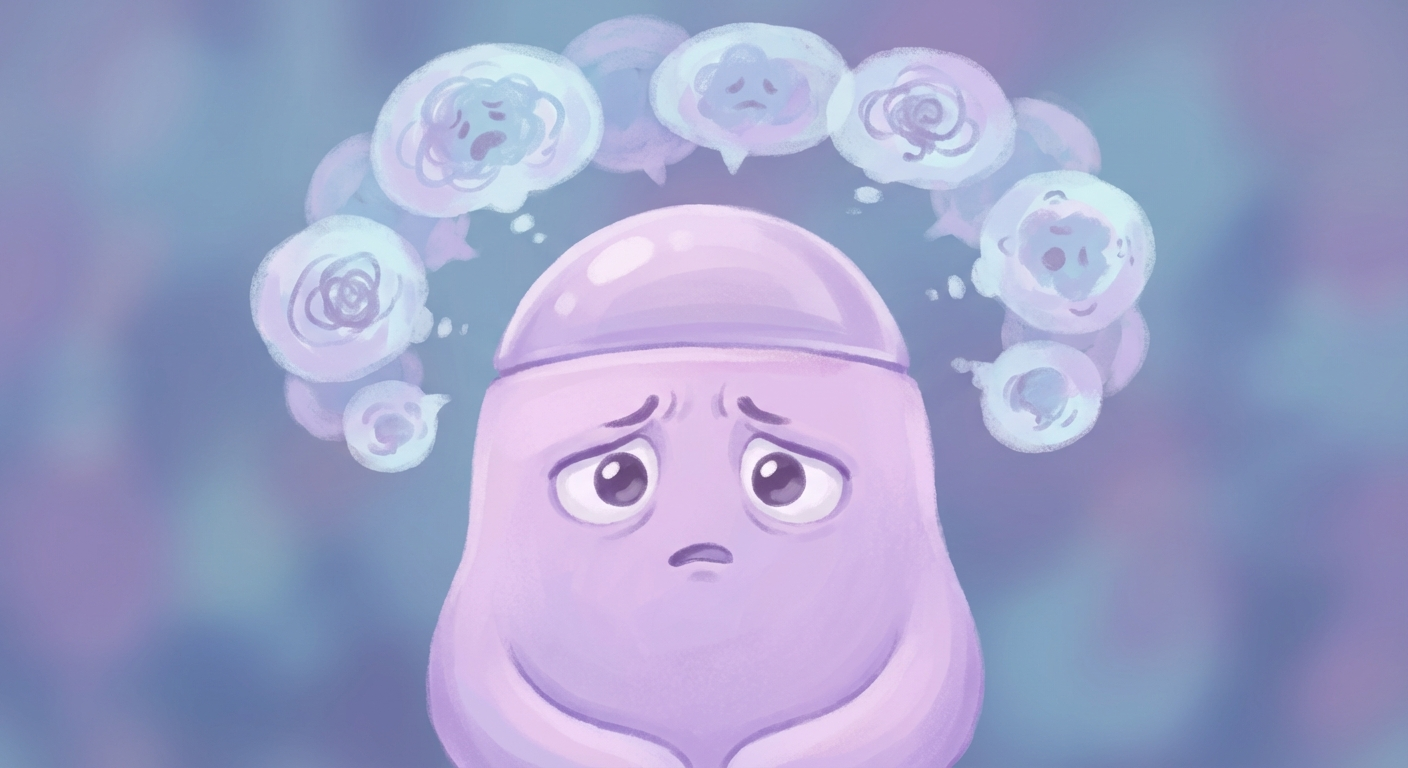
"Rumination is the repetitive, passive focus on distressing thoughts, feelings, or problems without moving toward action or resolution. Unlike productive reflection, rumination involves going over the same content repeatedly without gaining new insight or taking steps to address it."
It's 2 AM and you're replaying a conversation from three weeks ago. What you should have said. What they probably meant. What they might be thinking about you now. You've been over this dozens of times. You're not gaining any new insight. You're not solving anything. But your brain keeps circling back, playing the same mental film on repeat.
This is rumination—one of the most common and destructive patterns in human cognition. Unlike productive thinking that moves toward understanding or action, rumination is a closed loop. You're not analyzing to gain insight. You're not problem-solving to find solutions. You're just... chewing on the same painful material, over and over, making yourself feel worse without any benefit.
Rumination is strongly associated with both anxiety and depression. It predicts worse outcomes for existing mental health conditions and can trigger new episodes. It's a major factor in insomnia, relationship problems, and general misery. And most people don't even realize they're doing it—they think they're 'thinking things through' when they're actually making things worse.
Understanding what rumination is, why your brain does it, and how to break the cycle is one of the most impactful things you can do for your mental health.
Understanding and Breaking the Rumination Cycle
What Rumination Actually Is (And Isn't)
Rumination comes from the Latin word for 'chewing cud'—like a cow regurgitating and rechewing the same food. It's an apt metaphor. When you ruminate, you're mentally rechewing the same content without digesting it.
The key features that distinguish rumination from productive thinking are repetition without progress (you go over the same thoughts repeatedly without gaining new understanding or reaching conclusions), passive focus rather than active problem-solving (you're dwelling on the problem rather than working toward solutions), focus on feelings and their causes rather than on actionable steps, abstract questioning (Why did this happen? What does it mean about me? Why am I like this?) rather than concrete problem-solving, and intensification of negative mood rather than resolution.
Rumination is not:
Reflection: Genuine reflection involves examining experiences to gain insight, extract lessons, and integrate understanding. It has a beginning and an end. It makes you feel better or clearer afterward. Rumination is circular—it doesn't go anywhere.
Problem-solving: Problem-solving is active and goal-directed. You identify the problem, generate solutions, evaluate options, and take action. Rumination gets stuck on 'why' and 'what does it mean' without reaching 'what can I do.'
Processing emotions: Healthy emotional processing involves feeling your feelings, allowing them to move through you, and integrating the experience. Rumination keeps you stuck in the same feeling state, intensifying it rather than resolving it.
The tricky part is that rumination often feels productive. Your brain tells you that you're 'working on' the problem, that you need to 'figure this out,' that if you just think about it more, you'll understand. But the evidence doesn't support this. Research consistently shows that rumination makes mood worse, not better, and doesn't lead to insight or problem-solving.
Why Your Brain Gets Stuck in Loops
Rumination isn't a character flaw—it's a pattern that emerges from how brains work, especially under certain conditions. Understanding the mechanism helps you address it more effectively.
Incomplete processing: Your brain wants closure. When something distressing happens, your mind works to make sense of it, file it away, and move on. But some experiences resist easy resolution—they're ambiguous, they threaten your identity, they involve people you can't control. When the brain can't achieve closure, it keeps returning to the unresolved material, trying again and again to complete the processing.
Illusion of control: Rumination provides a feeling of doing something about a problem, even when you're not actually taking action. This is especially compelling when you feel helpless about the real situation. You can't change what happened or control what someone else does, but you can think about it—so thinking becomes a substitute for action.
Mood-congruent recall: When you're in a negative mood, your brain has easier access to other negative memories and interpretations. One painful thought leads to another, creating a cascade. This is why rumination tends to expand—you start with one problem and soon you're reviewing every failure of your entire life.
Learned pattern: If you've been ruminating for years, your brain has literally wired itself to do this. Neural pathways that fire together wire together. The groove is deep. Your brain goes to rumination automatically, without conscious choice.
Nervous system state: Rumination is more likely when your nervous system is dysregulated. If you're in a chronic stress state (sympathetic activation), your threat-detection system is overactive, and your brain keeps scanning for problems—including past problems that can't be changed.
Certain factors increase vulnerability to rumination, including history of depression or anxiety (rumination is both a symptom and a risk factor), perfectionism (there's always something to criticize), trauma history (unprocessed experiences keep resurfacing), high self-focus (attention directed inward rather than outward), and difficulty with emotional regulation.
The Damage Rumination Does
Rumination isn't just unpleasant—it's actively harmful. Research documents its role in initiating, maintaining, and worsening mental health problems.
Depression: Rumination is one of the strongest predictors of depression. People who ruminate are more likely to become depressed, stay depressed longer, and have more severe episodes. The content of depressive rumination—replaying failures, questioning self-worth, predicting negative futures—directly feeds the cognitive patterns of depression.
Anxiety: While anxiety often involves future-focused worry, rumination plays a role too. Past experiences become evidence for future catastrophes. The anxiety about past social interactions, for example, feeds rumination about what went wrong, which increases anxiety about future interactions.
Worse problem-solving: Ironically, all that thinking makes you worse at actually solving problems. Rumination consumes cognitive resources, creates emotional overwhelm, and keeps you focused on the problem rather than solutions. Studies show that induced rumination impairs problem-solving performance.
Sleep disruption: Rumination is a major cause of insomnia, particularly the kind where you can't fall asleep because your mind won't stop. The quiet and lack of distraction at night creates perfect conditions for rumination. And poor sleep makes rumination worse, creating a vicious cycle.
Physical health effects: Chronic rumination keeps stress hormones elevated, contributing to inflammation, immune dysfunction, and cardiovascular strain. It's not just mental suffering—it affects your body.
Relationship damage: Rumination about relationship issues tends to intensify negative feelings and decrease willingness to engage constructively. You build a case against the other person in your mind, making resolution less likely.
Learned helplessness: The passive quality of rumination—focusing on 'why' rather than 'what can I do'—reinforces a sense of helplessness. The more you ruminate, the more you feel like a victim of circumstances rather than an agent in your life.
Breaking the Loop: Evidence-Based Strategies
The good news is that rumination can be interrupted and the pattern can be changed. Multiple strategies have evidence supporting their effectiveness.
Behavioral activation: This sounds simple because it is: do something. Rumination thrives in passive states. Getting up, moving your body, engaging in an activity—anything that occupies your attention and creates sensory input—breaks the loop. The activity doesn't need to be pleasant or meaningful; it just needs to redirect attention and create a different physiological state.
Externalize attention: Rumination is internally focused. Deliberately shifting attention outward disrupts the pattern. The 5-4-3-2-1 grounding technique (five things you see, four you hear, three you touch, two you smell, one you taste) forces external focus. Describing your environment in detail works. Even watching a moderately engaging TV show beats rumination.
Scheduled 'worry time': This counterintuitive technique involves setting aside a specific time (say, 20 minutes) for rumination. When ruminating thoughts arise outside that time, you acknowledge them and postpone them to the scheduled period. This works because it's easier to postpone than to suppress. Often, by the time 'worry time' arrives, the urge has passed—or if you do ruminate, it's contained rather than all-day.
Problem-solving mode: If the issue you're ruminating about has a solution, force yourself into problem-solving mode. Write down: What specifically is the problem? What are possible solutions? What's my next concrete action? This shifts from the 'why' and 'what does it mean' of rumination to actionable thinking.
Self-compassion: Rumination often has a self-critical quality—you're beating yourself up while you chew on the problem. Self-compassion interrupts this. Treat yourself as you would a friend. 'This is really hard. It's understandable that you're struggling. What do you need right now?'
Accept uncertainty: Much rumination attempts to achieve certainty about things that can't be certain—what others think, how things will turn out, why something happened. Practicing acceptance of uncertainty ('I can't know for sure, and that's okay') reduces the drive to ruminate.
Mindfulness: Mindfulness training helps you notice when you're ruminating without getting pulled in. You observe the thought pattern—'There's rumination'—rather than being consumed by it. Over time, this creates space between the ruminating impulse and your response.
Nervous System Regulation and Rumination
Rumination is easier to break when your nervous system is regulated. When you're in a sympathetic (stressed) state, your brain is threat-focused, and rumination is a form of threat-scanning. When you're regulated, you have more capacity to notice the pattern and choose differently.
Body-first approaches can short-circuit rumination by changing your physiological state. Extended exhale breathing (breathe in for 4 counts, out for 6-8 counts) activates the parasympathetic nervous system, shifting you out of the stress state where rumination thrives. Cold water on your face or hands creates a physiological interrupt through the dive reflex. Movement—especially rhythmic movement like walking, dancing, or shaking—helps discharge the stress activation that fuels rumination.
The relationship between rumination and nervous system state goes both ways. Rumination keeps you stressed. Stress keeps you ruminating. Breaking the cycle at the body level (by regulating your nervous system) makes it easier to break at the cognitive level (by interrupting the thought pattern).
Timing matters: Rumination is worse at certain times. Late at night, when you're tired, when you're already stressed, after consuming distressing content. Noticing your vulnerable times allows you to preemptively implement strategies. If you know you ruminate at night, create a wind-down routine that includes nervous system regulation and attention externalization.
Some people find that addressing rumination at the body level first is more effective than trying to change thoughts directly. If you're caught in a loop, trying to think your way out can just create more thinking. Moving your body, regulating your breath, and changing your physiological state can shift you out of the mental space where rumination operates.
When Rumination Needs Professional Help
For many people, the strategies above can significantly reduce rumination. But sometimes the pattern is entrenched enough that professional support is needed.
Consider seeking help if rumination is constant or near-constant despite your efforts to change, if it's significantly impairing your functioning (work, relationships, daily activities), if it's accompanied by depression, anxiety, or other mental health symptoms, if it's preventing you from sleeping, or if you've tried self-help strategies consistently for several months without improvement.
Cognitive Behavioral Therapy (CBT) has strong evidence for reducing rumination. It helps you identify the patterns, understand what maintains them, and develop alternative responses. The focus is practical: changing specific thoughts and behaviors.
Rumination-Focused CBT (RF-CBT) is specifically designed for chronic rumination. It addresses the thinking style itself, not just the content. You learn to recognize the shift from productive thinking to rumination and to interrupt the process.
Mindfulness-Based Cognitive Therapy (MBCT) combines cognitive approaches with mindfulness training. It's particularly effective for preventing depressive relapse triggered by rumination.
Acceptance and Commitment Therapy (ACT) helps you change your relationship with thoughts rather than trying to control their content. You learn to have ruminating thoughts without being controlled by them.
Medication can help when rumination is part of depression or anxiety. SSRIs can reduce the intensity and frequency of rumination by modulating serotonin systems. This isn't a standalone solution, but it can make the cognitive and behavioral work more effective.
The goal of professional treatment isn't to never have repetitive thoughts—that's not realistic. It's to develop the capacity to notice rumination early and choose a different response before the loop takes hold.
Scientific Context
Research on rumination spans decades and consistently documents its role in depression, anxiety, and impaired problem-solving. Susan Nolen-Hoeksema's foundational work established the relationship between rumination and depression. Mindfulness-based interventions have demonstrated efficacy in reducing rumination.
Related Reading
Regulation shouldn't be work.
Rumination happens when your mind is stuck in a loop and your nervous system is dysregulated. Breaking the cycle requires interrupting both the thought pattern and the physiological state.
Nomie provides body-first regulation tools that can short-circuit rumination before it spirals. Breathing exercises shift your nervous system out of the stress state where rumination thrives. Grounding practices redirect attention from internal loops to present-moment sensation. Calming rituals replace the mental chewing with something that actually settles your system.
When the loop starts, reach for regulation before it takes hold.
Frequently Asked Questions
What is rumination?
Rumination is the repetitive, passive focus on distressing thoughts without moving toward resolution. Unlike productive reflection, it's circular—you go over the same content without gaining insight or taking action. It's associated with both depression and anxiety and tends to intensify negative mood rather than resolve it.
Why can't I stop ruminating?
Your brain is seeking closure on unresolved experiences and feels like thinking is 'doing something.' The pattern may be wired in from years of practice. Your nervous system state (chronic stress) keeps threat-detection active. And rumination itself is self-perpetuating—it keeps you in the mood state where more rumination is likely.
Is rumination the same as overthinking?
They overlap but aren't identical. Overthinking can include excessive analysis of any content. Rumination specifically involves repetitive focus on distressing material—past problems, negative feelings, self-criticism—without productive movement. All rumination is overthinking, but not all overthinking is rumination.
How do I stop ruminating?
Evidence-based strategies include behavioral activation (do something—anything), externalizing attention (5-4-3-2-1 grounding), scheduled worry time, shifting to problem-solving mode, self-compassion, accepting uncertainty, and mindfulness practice. Body-first approaches like breathing exercises and movement can also break the loop by changing your physiological state.
When should I get professional help for rumination?
Consider professional help if rumination is constant despite your efforts, significantly impairs functioning, accompanies depression or anxiety, prevents sleep, or hasn't improved after months of self-help. CBT, MBCT, and ACT all have evidence for reducing rumination. Medication can help when rumination is part of a broader condition.
Continue Reading
View All PostsNomie vs Finch: Somatic AI Wellness or Virtual Pet Gamification?
Finch gamifies self-care with a virtual pet bird. Nomie calms your nervous system with somatic tools. Here's which approach actually fits your needs.
Anxiety Dizziness and Lightheadedness: Why It Happens and What Helps
Feeling dizzy during anxiety can be terrifying—but it’s usually a nervous-system + breathing effect, not a sign you’re about to faint. Learn common causes and how to steady yourself.
Anxiety Tingling and Numbness: Causes, Meaning, and How to Stop It
Pins and needles during anxiety can feel alarming—especially in hands, face, or lips. Learn why it happens (often breathing + adrenaline) and how to calm it down safely.